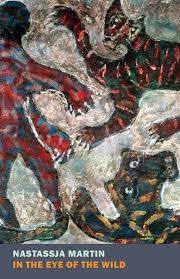
I recall going for a walk in Macedonia, early one Spring, and as I turned a corner of a mountainous path, there, a couple of hundred meters in front, was the prominent behind of a bear, wandering onwards, I thought a little drunkenly. It occurred to me later that if these bears hibernate perhaps this one was emerging from sleep, slimmer, still groggy, looking for the bearlike equivalent of one's first coffee. I cautiously reversed my steps and took a path less traveled. My one and only transitory encounter was over in a few seconds.
Nastassja Martin's encounter in Kamchatka, Russia's far eastern peninsula of ice and fire, was of a wholly other dimension. She is a French anthropologist and was engaged in fieldwork with the indigenous communities of the region. A number of whom, in the post-Soviet world, have returned to the forest after their mostly harrowing experience of collectivization.
Her friends amongst the indigenous had already noticed a 'bear affinity' with which she had concurred and when she meets one on a path down a local volcano - both of them out of the forest in unusual circumstance - she does not, as one might expect attempt to flee but meets the bear head-on in blazing conflict. The bear severely, disfiguringly bites her head and leg, she wounds the bear with her ice pick. It flees and she is rescued.
What follows is a compelling account of both the trauma of her medical treatment - in Russia and France - and her meditation on the meaning of the encounter for nothing of its reality seems accidental.
At which point the book becomes at once enthralling and saddening.
Enthralling because of its exploration of a world that is full of persons, only some of whom are humans, and what might it mean to be marked by a bear, to become in the eye of her indigenous companions, 'medka' - half-human, half bear. What does this mean for one's identity? I may not be a whole self, unified entire, but a collaborating body of selves that cross boundaries between the human and the non-human other, that reflect off each other, making new patterns of possibility. What might it be like to allow oneself to be wrapped in this world for it to become the abiding reference for all one's actions? Animism re-animated in the life of a sophisticated Western academic.
But why was I saddened? Not for the author or their wrestling with their experience and its context - and her implied commitment at the end for her to allow it to transform her whole approach to understanding - to be immersive rather than simply participatory - but because of our neglect of this way of knowing, including in myself.
No wonder that Daria, one of her indigenous helpers, who is nothing less than a second mother to Nastassja, speaks so obliquely of what she understands - partly because any truth perhaps always needs to be approached side on, reverently, not stared at square (never look a bear in the eye) but also, you suspect, because of the difficulty that any of us, secularised, has of being present in this animated world. We must appear so crassly blinkered, blundering on, out of sight of the obvious. You come away too reminded of that Wittgenstein maxim that truth is shown, not told, or perhaps acted, not said, might be more accurate yet.
My companion is not a bear but a heron - specifically a grey heron - that once was persecuted mercilessly in Switzerland but has survived, flourishing. How can I describe the fact that with this bird, I am in a relationship, that its appearances can be accidental but often are not; and, that I know the difference and it is not a projection. This is, of course, the 'pathetic fallacy' the outer, and the inner, critic will say - except it is not - and so we go around ...
But one of the virtues of this book is the reinforcement of what one knows - even if one steps into what one knows rarely - that the world is a conversation between persons, only some of whom are human, and in spite of all our attempts to monopolize the conversation for ourselves, making it a monotonic monologue, the other voices go on, and can break-in at any time, sometimes as here with a necessary violence.
Finally, there is, in the text, an appropriately oblique reference to the consequences of us neglecting this dialogue. Martin suggests at one point that the world we have created, this non-participative, dominated landscape of living, is directed towards collapse - and her indigenous companions are already alert to this, having lived through their local Soviet version, and are already navigating around the wreckage. Need it be like this or is it time to learn a renewed, immersive language of animation.
Thank you, once again. Beautiful. So grateful for herons, bears and myriad partners in conversations.
ReplyDelete