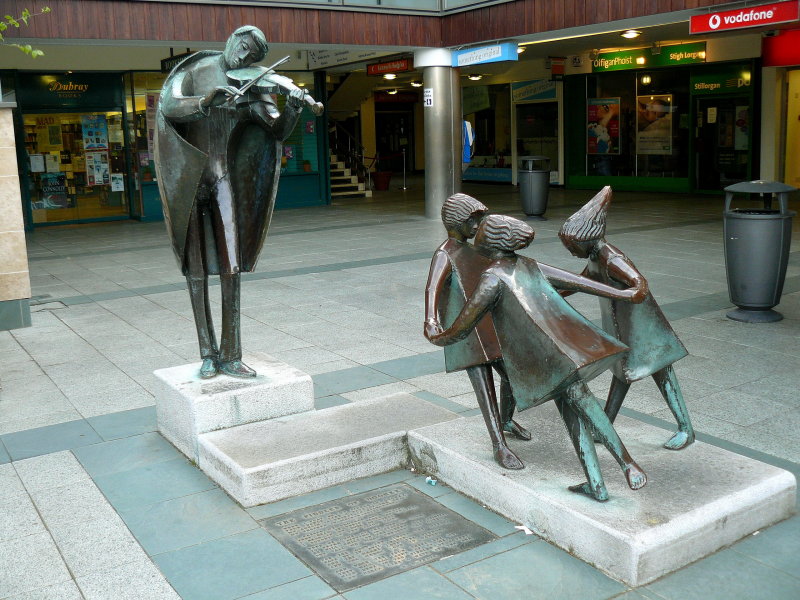
The Fiddler of Dooney by W.B. Yeats


The Fiddler of Dooney


"WHEN I play on my fiddle in Dooney,
Folk dance like a wave of the sea;
My cousin is priest in Kilvarnet,
My brother in Moharabuiee.


I passed my brother and cousin:
They read in their books of prayer;
I read in my book of songs
I bought at the Sligo fair.


When we come at the end of time,
To Peter sitting in state,
He will smile on the three old spirits,
But call me first through the gate;


For the good are always the merry,
Save by an evil chance,
And the merry love the fiddle
And the merry love to dance:


And when the folk there spy me,
They will all come up to me,
With ‘Here is the fiddler of Dooney!’
And dance like a wave of the sea."


This is a beautifully, and deceptively, simple poem.


But as any good Platonist would know (and Yeats was most surely that) ‘dancing like the wave of the sea’ is precisely an image of matter informed spirit: a harmonious alignment of worlds, a fullness of truth’s embodiment. And too that the good is analogous with joy (unless temporarily hidden by the incursions of evil) and joy springs out of and into that happy alignment of informed spirit that is the dance.


And that this ‘older’ tradition carries a priority over the learning of the priest – that the folk carry it in song and that Ireland carried it in anticipation of Christ’s coming – is a theme of Yeats (and of the Celtic revival generally).


A simple lyric carries great freight with a lightness of touch that is the indicator of a traditional imagination.

Comments

Popular posts from this blog

The Buddha meets Christ in embrace

Reading Lama Anagarika Govinda is proving nostalgic on a number of fronts. I recall my first reading of it in my first year at university, bought at Watkins, the famous 'esoteric' bookshop in Cecil Court in London. I sat in my hall of residence room transfixed by a world made familiar; and, it was deepening of a commitment to contemplation (which has been observed fitfully)! I remember returning, at the time, to my school to give a talk to the combined fifth form on Buddhism and using Govinda as the backbone of my delivery (both this book, and his equally wonderful, the Foundations of Tibetan Buddhism). I was voted (I immodestly remember) their best invited speaker of the year. I had even bought a recording of Tibetan music as opener and closer! He reminded me of how important Buddhism was (and is) to my own thinking and comprehension of my experience. The Buddha's First Sermon in the Deer Park was the first religious text I read (of my own volition) at the tender age...

Luminous Spaces - the poetry of Olav H. Hauge

Don't give me the whole truth, don't give me the sea for my thirst, don't give me the sky when I ask for light, but give me a glint, a dewy wisp, a mote as the birds bear water-drops from their bathing and the wind a grain of salt. It began with a poem, this poem, in Mark Oakley's 'The Splash of Words: Believing in Poetry' - a wonderful series of meditations on particular poems, one each chapter. The poet is the Norwegian, Olav H. Hague (1908-1994). I immediately ordered, 'Luminous Spaces: Selected Poems & Journals' and was enjoying dipping until, at the weekend, recovering from a stomach bug, I decided to read them through and fell wholeheartedly for a new friend. Hague was born on a farm. His formal education was brought short by a combination of restricted means, an inability to conquer mathematics: and, a voracious diet of reading ranging beyond the confines of any confining curriculum. He went to a horticultural college instead an...

Red Shambala

Nicholas Roerich is oft depicted as a spiritual seeker, peace visionary, author of numberless paintings, and a brave explorer of Central Asia. However, Andrei Znamenski in his 'Red Shambala: Magic, Prophecy, and Geopolitics in the Heart of Asia' has him perform another role - that of geopolitical schemer. The scheming did have at its heart a religious vision - of a coalition of Buddhist races in Central Asia that would establish a budding utopia - the Shambala of the title - from which the truths of Buddhism (and co-operative labour) would flow around the globe. This would require the usurpation of the 13th Dalai Lama to be replaced by the Panchen Lama guided by the heroic saviour (Roerich) who appears above dressed for the part. In the achievement of these aims, the Roerichs (including his wife, Helena, who had a visionary connection with 'Mahatmas' whose cryptic messaging guided their steps) were willing to entertain strange bedfellows that at one time include...